Full disclosure up front: we build Fly Overhead, so we have a horse in this race. But most “EFB comparison” articles are either thinly disguised ads or five years out of date, and pilots deserve better. Here is where ForeFlight, Garmin Pilot, and Fly Overhead actually stand in 2026 - prices checked July 2026, gaps included, ours too.
The short answer
ForeFlight is still the default. It has the most polished interface, the deepest feature set, and it is what most flight schools teach on. It is also iPad-and-iPhone only and the most expensive of the three. Garmin Pilot costs less at comparable tiers, runs on Android as well as iOS, and is the obvious pick if you fly behind a Garmin panel. Fly Overhead is the newer entrant: a web-first EFB that runs on anything with a browser, pairs a free live ADS-B map with AI route briefings and 3D airspace at a fraction of the other two's price, and adds a CFI-student workflow neither of the legacy apps has. It doesn't yet match their depth everywhere, and we'll be specific about where.
| ForeFlight | Garmin Pilot | Fly Overhead | |
|---|---|---|---|
| Price (individual, per year) | $130 / $260 / $390 | ~$110 / ~$210 | $95.88 / $167.88 (billed monthly at $7.99 / $13.99) |
| Platforms | iPad, iPhone, web planning | iOS, Android, web planning | Any browser today (iPad, iPhone, Android, laptop, desktop); native iOS + Android apps coming soon |
| 3D airspace + terrain | 3D airport views only, Premium tier ($390/yr) | Not offered | Yes - 3D airspace shells and terrain mesh from $4.99/mo |
| CFI / student tools | Digital endorsements only | Digital endorsements only | Student roster, flight review + countersign, maneuver grading, checkride readiness |
| Flight plan filing | In-app | In-app | Handoff to 1800wxbrief today; direct in-app filing coming soon |
| Free tier | No (30-day trial) | No (30-day trial) | Yes - live tracking map, forever |
ForeFlight in 2026: still the standard, no longer the same company

ForeFlight went through a big year. Boeing, its owner since 2019, sold it in 2025 as part of a $10.55 billion sale to the private-equity firm Thoma Bravo, and the business relaunched as a standalone company called Jeppesen ForeFlight. The subscription tiers were renamed around the same time: Basic Plus became Starter, Pro Plus became Essential, and Performance Plus became Premium. In February 2026 prices went up again, roughly 4 to 5 percent: Starter is $130 per year, Essential is $260, and Premium is $390.
What you get for that money is genuinely good. Starter covers VFR and IFR charts, flight planning and filing, weather, airport information, a digital logbook, and checklists. Essential is the popular one - it adds synthetic vision, Hazard Advisor terrain alerting, geo-referenced approach plates and taxi diagrams, the profile view, and richer weather layers like icing and turbulence. Premium adds aircraft performance profiles, landing performance, 3D airport views, pre-departure clearances, and contract-fuel integration for turbine operators. Pair it with a Sentry ADS-B receiver and you get traffic and weather in flight.
For instructors, ForeFlight's logbook has an endorsement tool: a CFI can hold a digital signature and send a student a specific endorsement - solo, checkride prerequisites, flight review - which the student accepts into their own logbook. It stops there; there is no ongoing student roster, flight-by-flight review, or grading system inside the app pilots already pay for.
The honest case for ForeFlight: it is the most refined app in the category, the weather visualization is best in class, and because nearly every flight school in the country teaches on it, your CFI can look over your shoulder and know exactly what they are seeing. The honest case against: it does not run on Android and ForeFlight has said it has no plans to change that, the price has climbed almost every year, and a private-equity owner has pilots on the forums wondering out loud which direction pricing goes from here.
Garmin Pilot in 2026: SmartCharts and the panel advantage
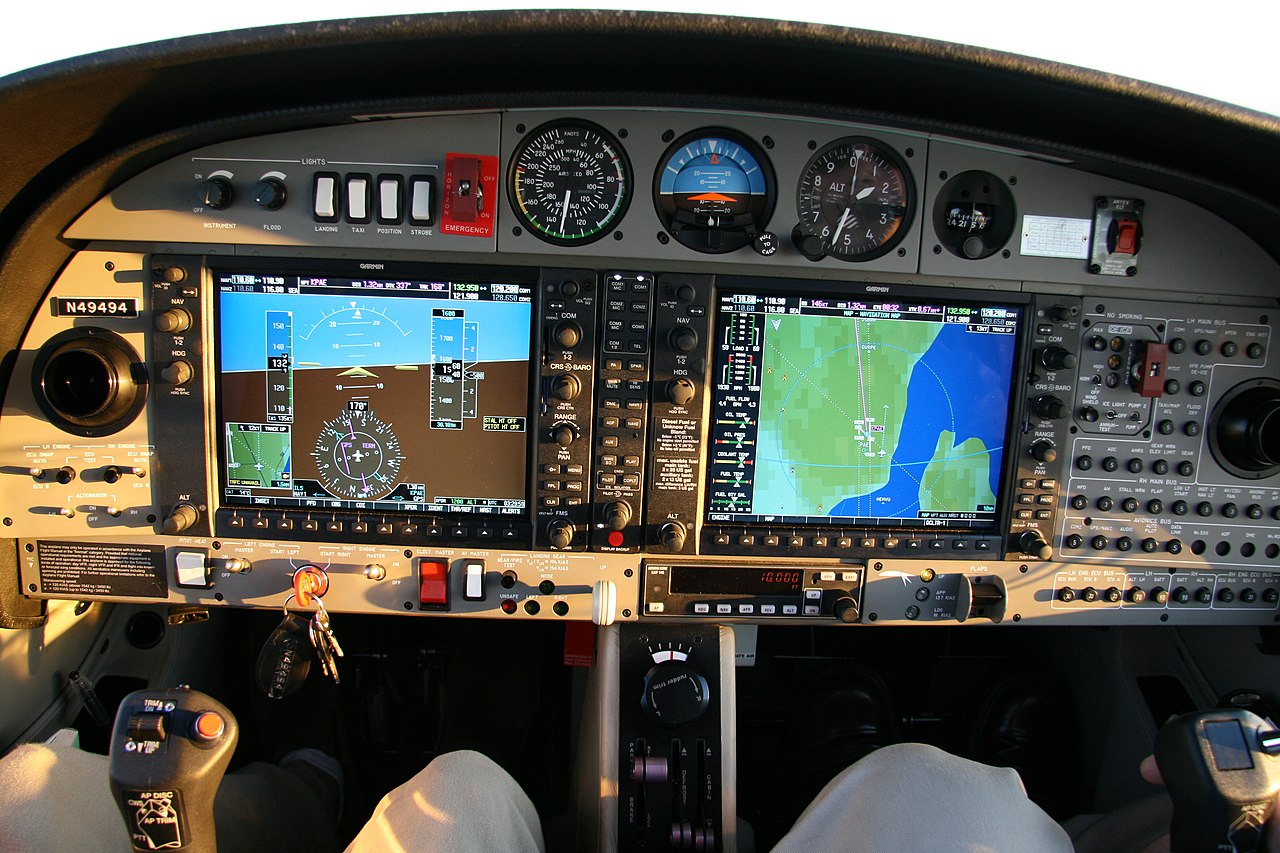
Garmin Pilot runs about $110 per year for the Standard tier and about $210 for Premium, one subscription covers three devices, and it runs on both iOS and Android - the only one of the two legacy EFBs that does. Standard covers charts, flight planning and filing, weather, and the moving map. Premium adds synthetic vision, terrain and obstacle alerting, geo-referenced plates, SafeTaxi diagrams, graphical weight and balance, and icing forecasts. A browser-based planning app, Garmin Pilot Web, is included with the subscription.
The headline feature is SmartCharts: approach plates rebuilt as live data instead of static images, so the chart highlights applicable minimums, folds current weather and NOTAMs into the plate, and overlays NOTAMs graphically on the airport diagram. It is the biggest advance in EFB charting in years, and right now it is ahead of ForeFlight's equivalent, Dynamic Procedures - and, for what it's worth, ahead of anything we've shipped too (more on that below). The other structural advantage is Connext: if your panel has Garmin avionics with a Flight Stream, flight plans move between the tablet and the navigator wirelessly, and the app inherits panel-style Direct-To and Nearest buttons and an emergency glide-range mode.
Garmin Pilot's logbook has the same shape as ForeFlight's on the instructor side: an endorsement tracker with instructor sign-off for pre-solo, 90-day solo, flight reviews, IPCs, and custom endorsements. No student roster, no flight review or countersign workflow, no maneuver grading.
The honest case against Garmin Pilot is mostly about feel. The interface is denser and more engineer-shaped than ForeFlight's, the learning curve is steeper, and for years the app played feature catch-up, which is why fewer schools teach on it. Pilots who switch tend to be happy; the switch itself takes effort. Worth knowing: Garmin also owns FltPlan Go, which remains the best genuinely free full EFB if your budget is zero.
Fly Overhead in 2026: the live map, the AI, and what's next
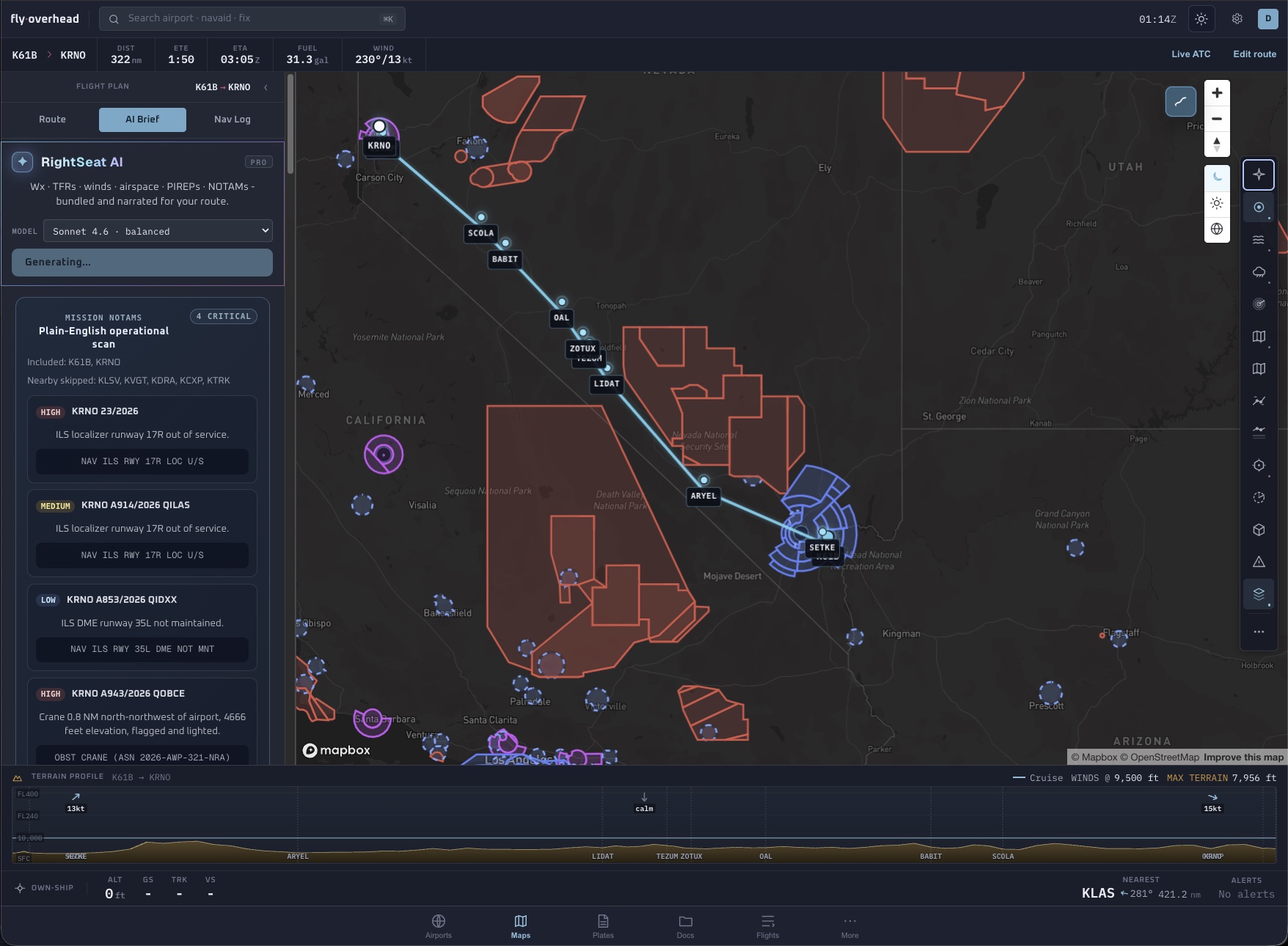
Fly Overhead started as a live flight tracker and grew into an EFB, and that history shapes what it is. The foundation is a real-time ADS-B network: the live map is free, forever, no account required. The EFB sits on top of that - VFR sectionals, IFR low and high charts, approach plates, METARs, TAFs, NOTAMs, live PIREPs, and a turbulence layer inferred by machine learning from how actual aircraft are getting bounced around at each altitude band. We're also the only one of the three with true 3D airspace - Class B, C, and D rendered as shelves with labeled floors and ceilings - and 3D terrain, and we offer both starting at $4.99 a month. ForeFlight's closest equivalent is 3D airport views, gated behind its $390/year Premium plan; Garmin Pilot doesn't offer anything like it.
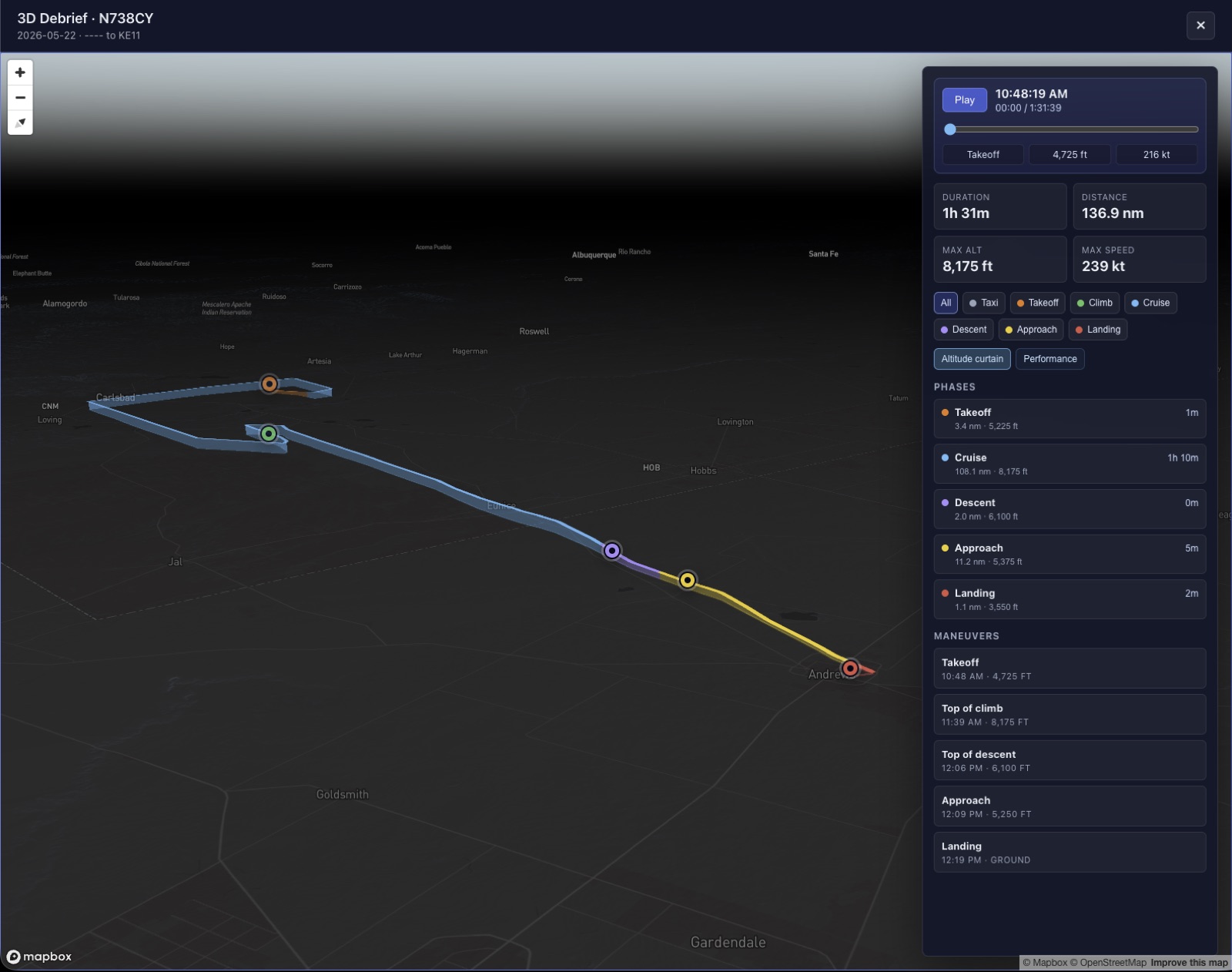
The part we think genuinely moves the category forward is the AI. The RightSeat copilot builds a full pre-flight brief grounded in your aircraft's POH numbers, current weather, density altitude, terrain, and NOTAMs; compares departure windows across the day; suggests altitudes by fuel burn against winds aloft; and reroutes around active special-use airspace. After the flight, a voice debrief turns a spoken memo into a logbook entry, the smart logbook auto-imports your flights from our own ADS-B data with FAR 61.57 currency tracking, and the 3D debrief replays the flight with phase coloring and a maneuver timeline.
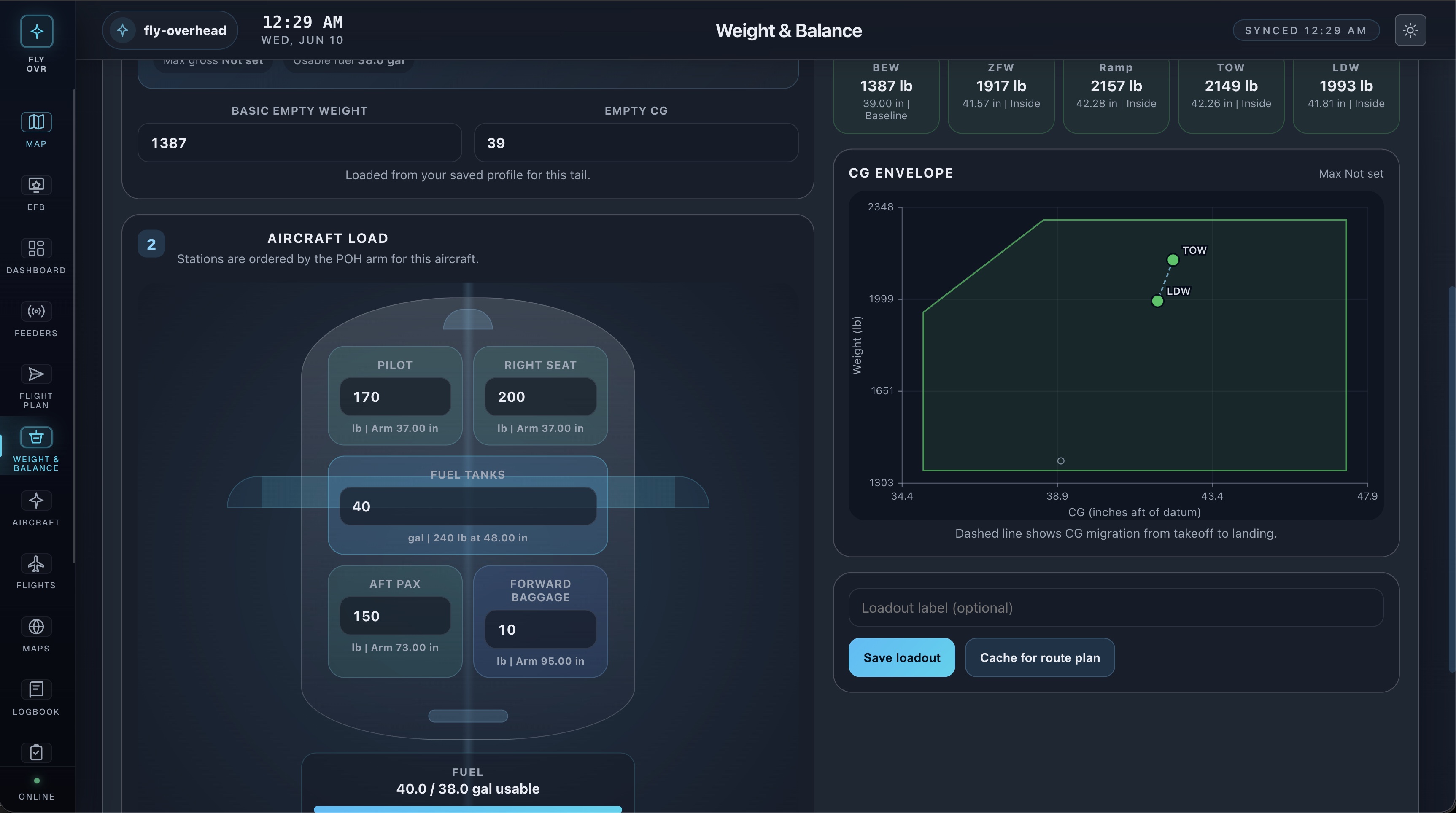
Because Fly Overhead is a progressive web app, it runs on an iPad, an iPhone, an Android phone or tablet, and - unlike either competitor's full app - on your laptop or desktop, all from one subscription. Plan tonight's flight on a big monitor, walk out to the plane, and the same brief is cached on your phone with no signal on the ramp. Dedicated native iOS and Android apps are coming soon on top of that, for pilots who want a home-screen icon and OS-level integration. EFB Basic is $7.99 per month and covers charts, the logbook, currency tracking, and short AI briefs. EFB Pro is $13.99 per month and adds full RightSeat briefs, voice debrief, and the 3D debrief. Annualized, the Pro tier costs less than ForeFlight's cheapest plan.
Built for CFIs and flight schools, not just solo renters
This is the feature we don't think gets enough attention in EFB reviews. Neither ForeFlight nor Garmin Pilot lets a CFI actually manage students inside the app - both cap out at a digital endorsement signature, a one-way acknowledgment for a specific requirement. Fly Overhead builds the CFI-student relationship in directly: a CFI sees a roster of linked students, opens any student's flight, reviews and countersigns it, grades individual maneuvers on a 1-to-5 scale, and tracks checkride readiness against the actual FAR 61.109 experience requirements - dual, solo, cross-country, night, instrument - as the student flies, alongside FAR 61.57 currency.
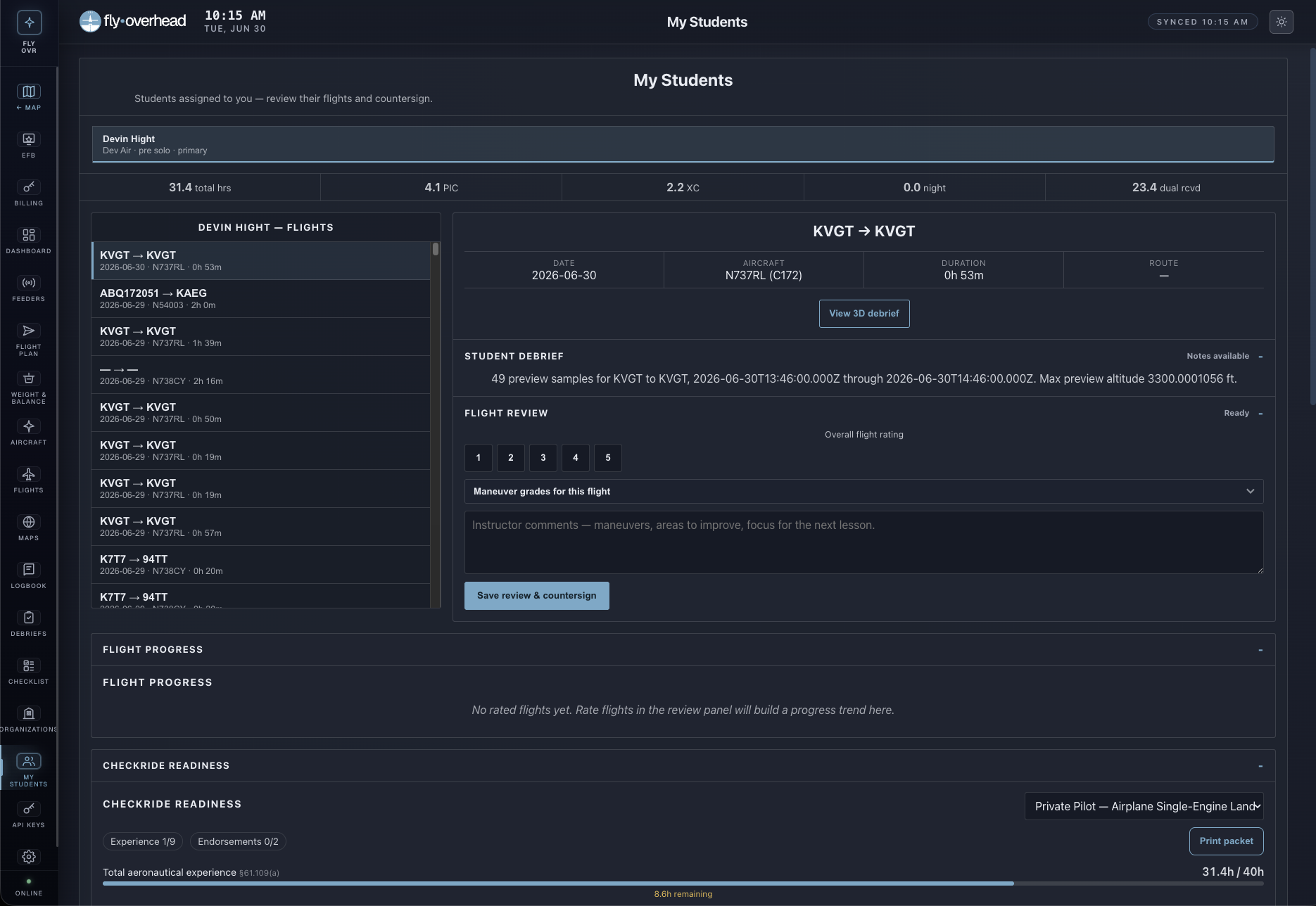
It's built for the independent CFI as much as the flight school: link a student with an invite, and both of you are working from the same flight data, automatically imported from ADS-B, with no separate logging step. We think this is a real gap in the category, not a nice- to-have, and it's a big part of why we built Fly Overhead the way we did.
What we're building next
A few things worth naming plainly, since we'd rather tell you what's in progress than let a comparison post pretend the category stands still. Direct in-app flight plan filing to the FAA's Leidos system is coming soon, to replace today's handoff to 1800wxbrief. We're also building our own take on data-driven, interactive approach plates - live minimums and NOTAMs folded directly into the chart, in the spirit of what Garmin's SmartCharts does today. And dedicated native iOS and Android apps are on the way alongside the PWA, for pilots who want a home-screen icon rather than a browser tab.
Coverage today is centered on the contiguous United States, but that's changing: we're in active discussions to add European coverage, and we already have initial aeronautical and weather/airspace data for parts of the Middle East. What we don't have yet, honestly: synthetic vision, a Connext-style wireless link to a certified panel, and a dedicated portable ADS-B receiver ecosystem like Sentry or the GDL series. Like every EFB on this page, certified or not, Fly Overhead is advisory only.
Which one fits how you fly?
- Renting from a school, or training toward a checkride: ForeFlight is the safe, familiar choice your instructor already knows - though ask if your school's CFIs are using Fly Overhead's student tools alongside it, since the two aren't mutually exclusive.
- Flying behind Garmin glass: Garmin Pilot's Connext sync and SmartCharts are real advantages if your panel is Garmin avionics.
- On Android, budget-conscious, planning from a desktop, or a CFI who wants student tools built in: that's the case we built Fly Overhead for. The live map costs nothing, so you can try the core of the product before paying anyone.
None of this is exclusive. Plenty of pilots keep the free Fly Overhead map open for live traffic awareness and use the voice debrief, auto-imported logbook, and My Students tools alongside an existing ForeFlight or Garmin Pilot subscription. All three offer a low-risk way in - ForeFlight and Garmin Pilot each have a 30-day free trial, and Fly Overhead's map tier is simply free, forever.